
Polypore: Game Information
Project Length – 35 Weeks
Project Team Size – 6 People
Project Role – Designer, Producer
Engine – Unreal Engine 5
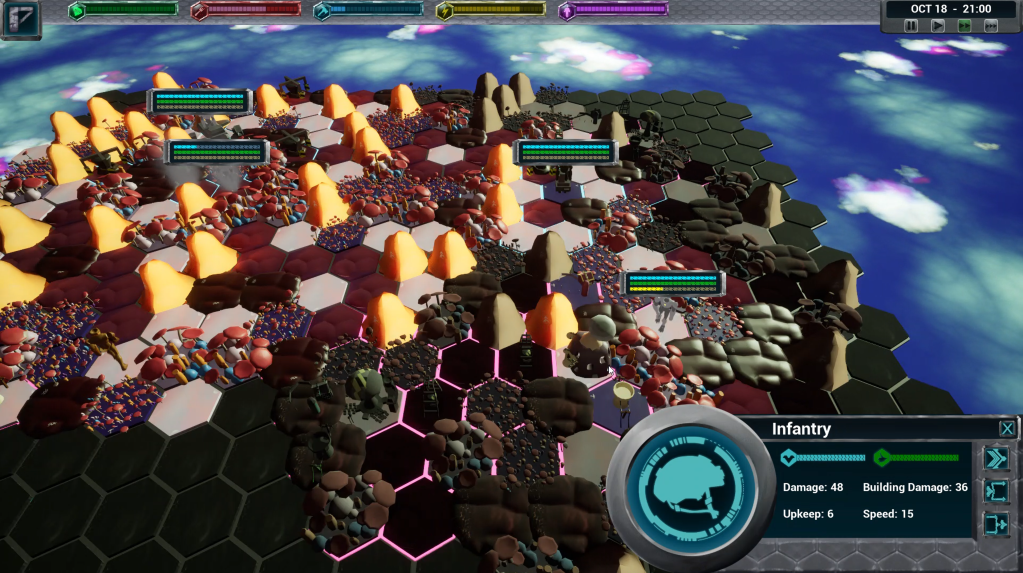
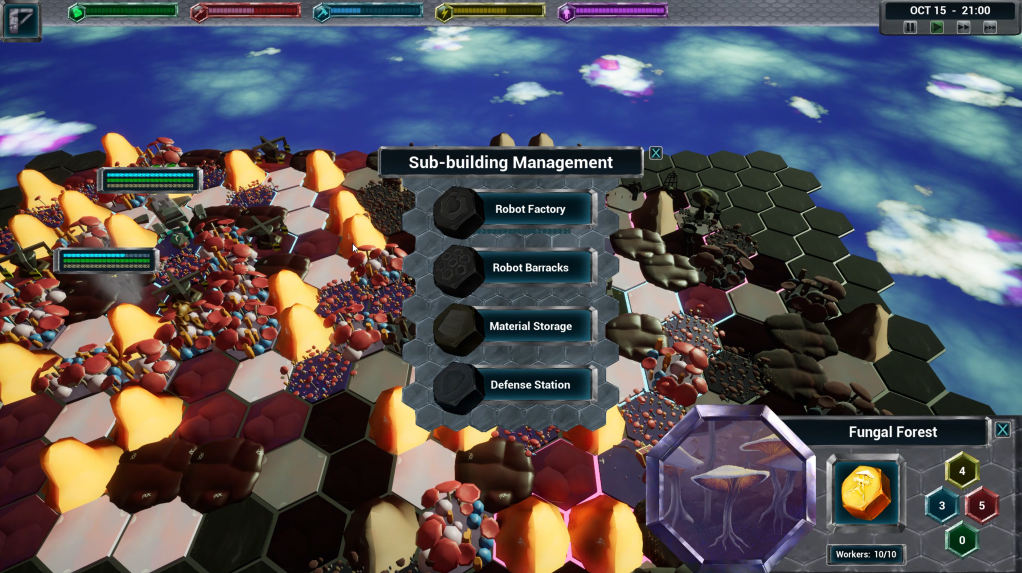
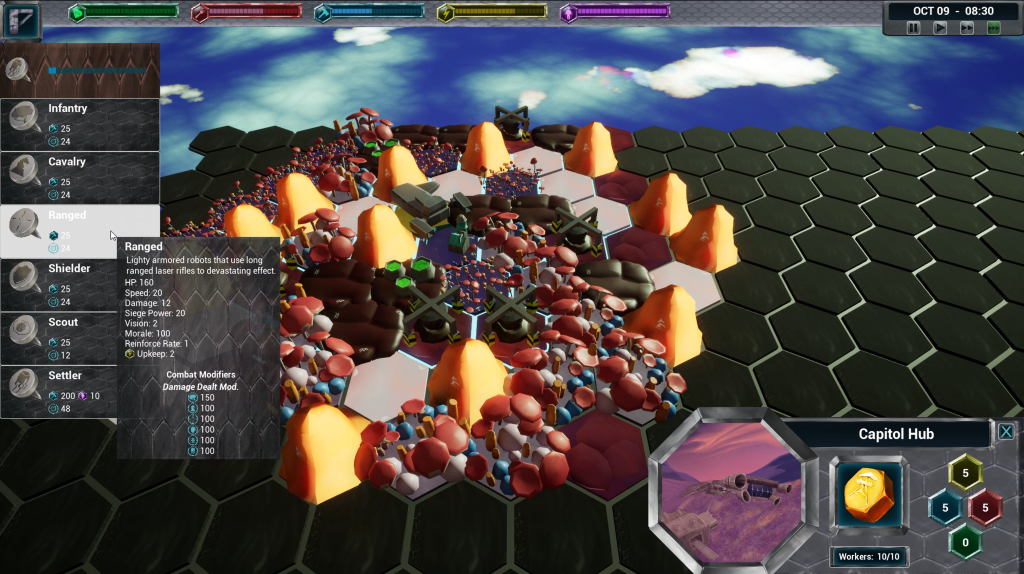
Polypore is a real-time, 4X , strategy, tile-based map game where you play as a the captain of a group of human survivors who have crashed onto an unknown fungal alien planet. You must allocate workers, produce resources, and built robot soldiers to explore the world and obtain the fuel you need to escape the planet. The trailer can be viewed in the YouTube video and the game can be played here.
Link to Play Game: https://polyporebeta.itch.io/polypore-beta


My Role: Production
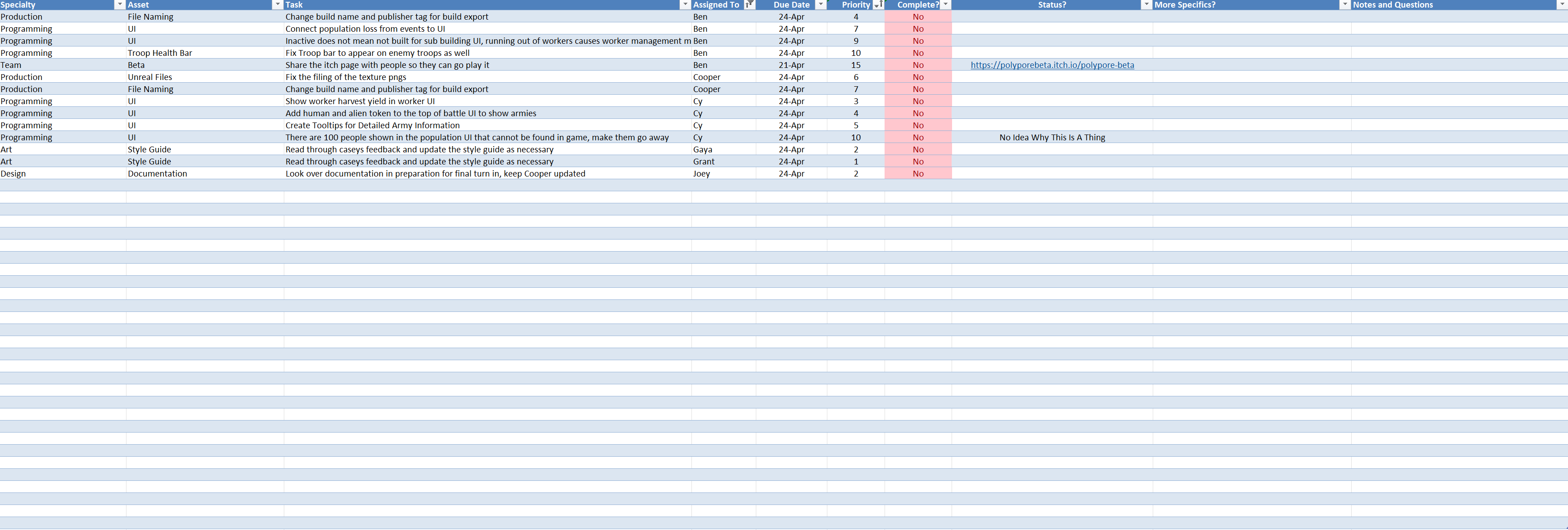
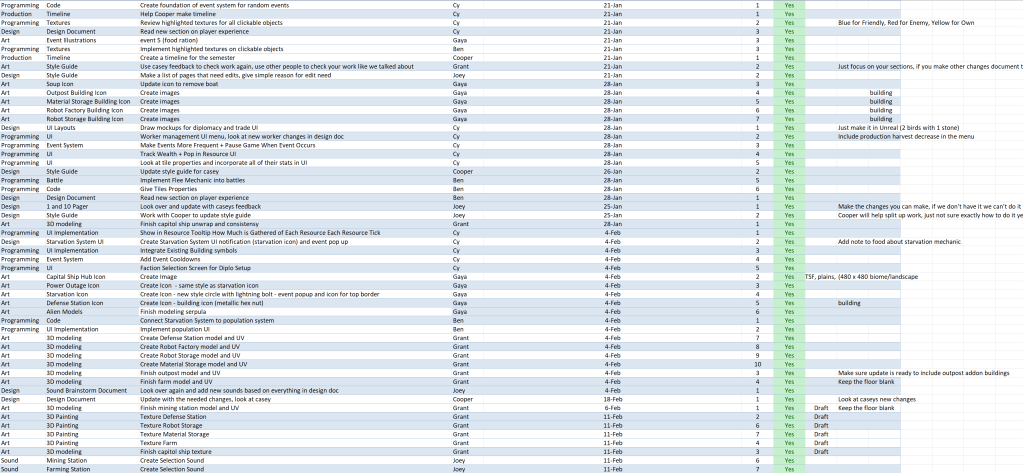
I was responsible for leading and managing our team, planning out our tasks, creating a production schedule and asset list, ensuring the team stayed on track, and making changes to the production schedule as needed. All of our tasks were tracked in Microsoft Excel, using a table that I would update a 3-4 times a week.
For this project, the asset list and production schedule were combined into one document. My strategy for creating this was to make tasks for all the assets that needed creation and moving their priority order around each week, creating and removing assets as needed. This worked ok, but the large amount of assets made the list hard to read at times, so going forward I will be keeping those on separate pages.
Once a week, our whole team met and discussed what tasks were completed during the last week of work. I would spend about an hour or two before the meeting looking over the tasks and coming up with a rough idea of what tasks I wanted to assign for the next 2-3 weeks. I had a rough timeline for the 35 weeks we had to work on it, so I based my decisions on matching that timeline as much as possible. Once the meeting started, I would have them give me a rundown of what they did throughout the week, checked the work they said they completed, and then marked it off in the excel sheet. I asked them to mark off the excel sheet as tasks were completed, but I always double-checked the task was done before removing it from the sheet.
After updating the production schedule, I would talk them through what I wanted them to work on and come to a consensus about what would be assigned for the week. After agreeing to the tasks, I would document them and check in throughout the week to make sure tasks were getting done as planned, making changes to those tasks and the timeline if challenges or unforeseen circumstances came up.
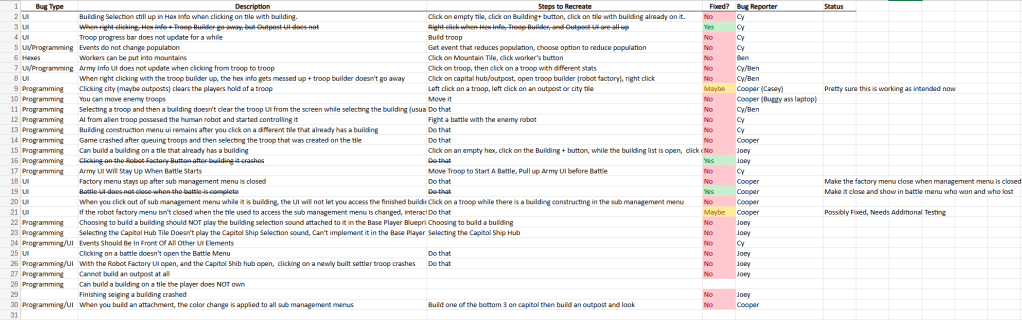
This excel document was also used to track bugs that were found during the development process. If anyone found a bug, they would record it on a different sheet and bring it up during the meeting to ensure it was communicated to the team, if it wasn’t already discussed before. I would use this sheet to make sure that bugs were being fixed and would assign some of the bugs as tasks to fix during my prep for weekly meetings.

My Role: Design
I was responsible for designing all gameplay elements, creating and balancing the economy system for gaining and spending resources, creating the random events, creating the tutorial content, and creating the game design document.
When creating the gameplay elements, I centered my design around controlled randomness that creates unique situations each playthrough. The tiles types, tile resource yield, alien civilizations, alien personalities, and alien locations are all different each game. The player cannot go into each game and use the same strategy because their setup and adversaries will be different each time, they will have to adapt to their situation to figure out the best way to escape the planet. Each tile has a unique effect that changes how the tile is used, making the random spawns of the tiles potentially beneficial or hurtful to the player. Each troop type has a benefit and drawback, some are based around combat and counter other troop types, some are based around movement speed, and some are secondary effects unrelated to combat. Each building benefits the player, either through resource yield, troop creation and storage, or defense, but the cost of each is a higher resource upkeep cost. Decisions that worked in the early game may not work as well as the game progresses, you have to recognize when that is happening and make adjustments as needed.
I built the economy system to be centered around the average materials a player can gain each second. I used the average resource output per tile and the amount of tiles the player has access to in the beginning of the game to find the average resource gain over a certain amount of time. With that number, I based the costs of all troops and buildings around how long it would take the player to get to that number. The early game needs some strategy to make sure you don’t expand too quickly, the middle game is focused on ensuring you have enough resources to support troop creation and upkeep, and the endgame is centered around protecting those resources from increased aggression to ensure you have enough resources to escape the planet. The player can also to trade with friendly alien civilizations, making it possible for them to get the resources they need when they have unfavorable spawns.
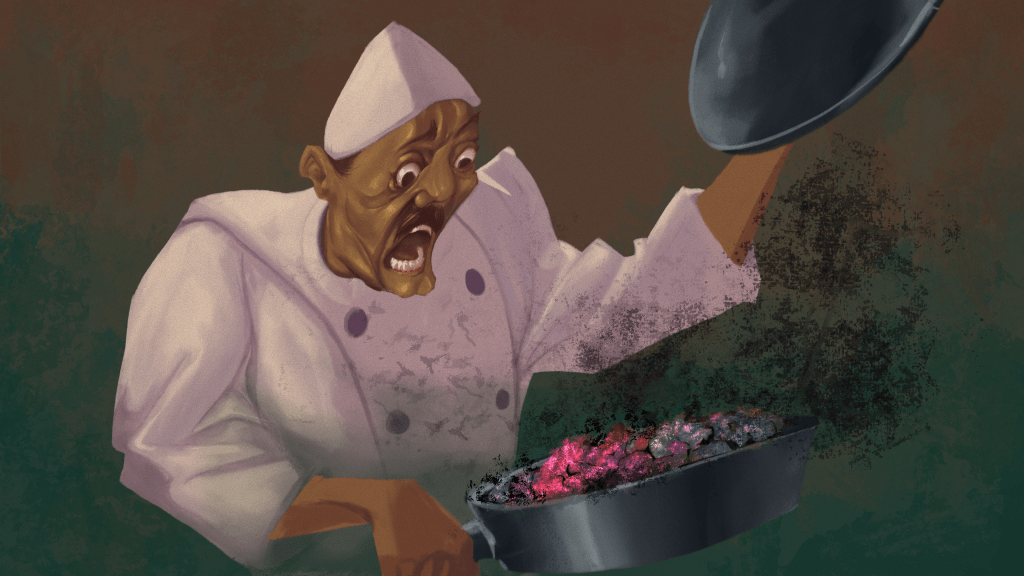
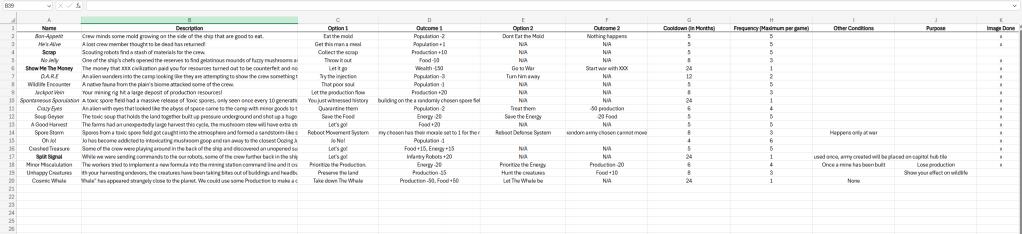
The random events provide more uniqueness to each playthrough, forces the player to make sacrifices, and creates a vehicle to deliver world lore and story. Some events give the player a choice on how they want to respond and some do not. A picture of the events created for the beta can be seen in the picture gallery. The tutorials are an extension of the events that the player sees if they start a game with the tutorials enabled. Each tutorial gives the player information about what they should be doing to get out of the early game.
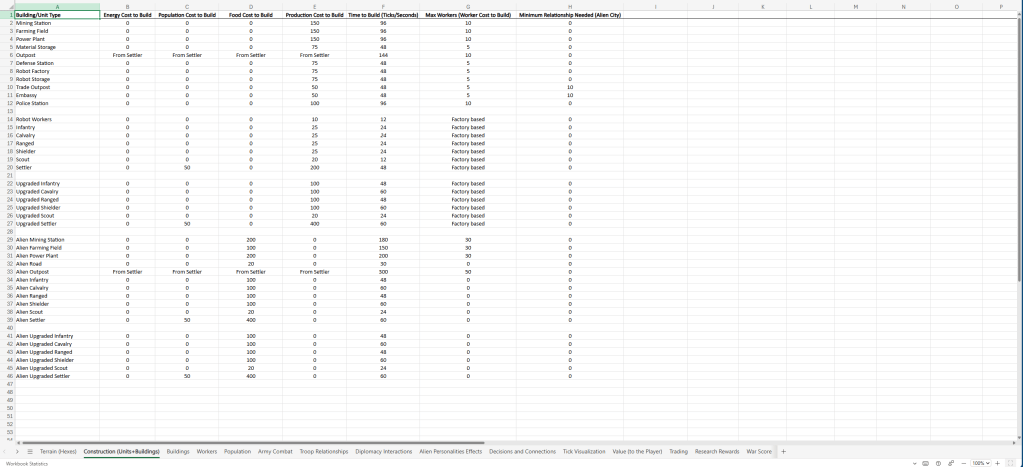
The game design document includes all of this information, as well as stats for each element of the game. While it is mostly text, it includes some pictures and tables to visualize the game flow and other design decisions. The design document for this game can be viewed and downloaded here.


 Cooper Fink Game Portfolio